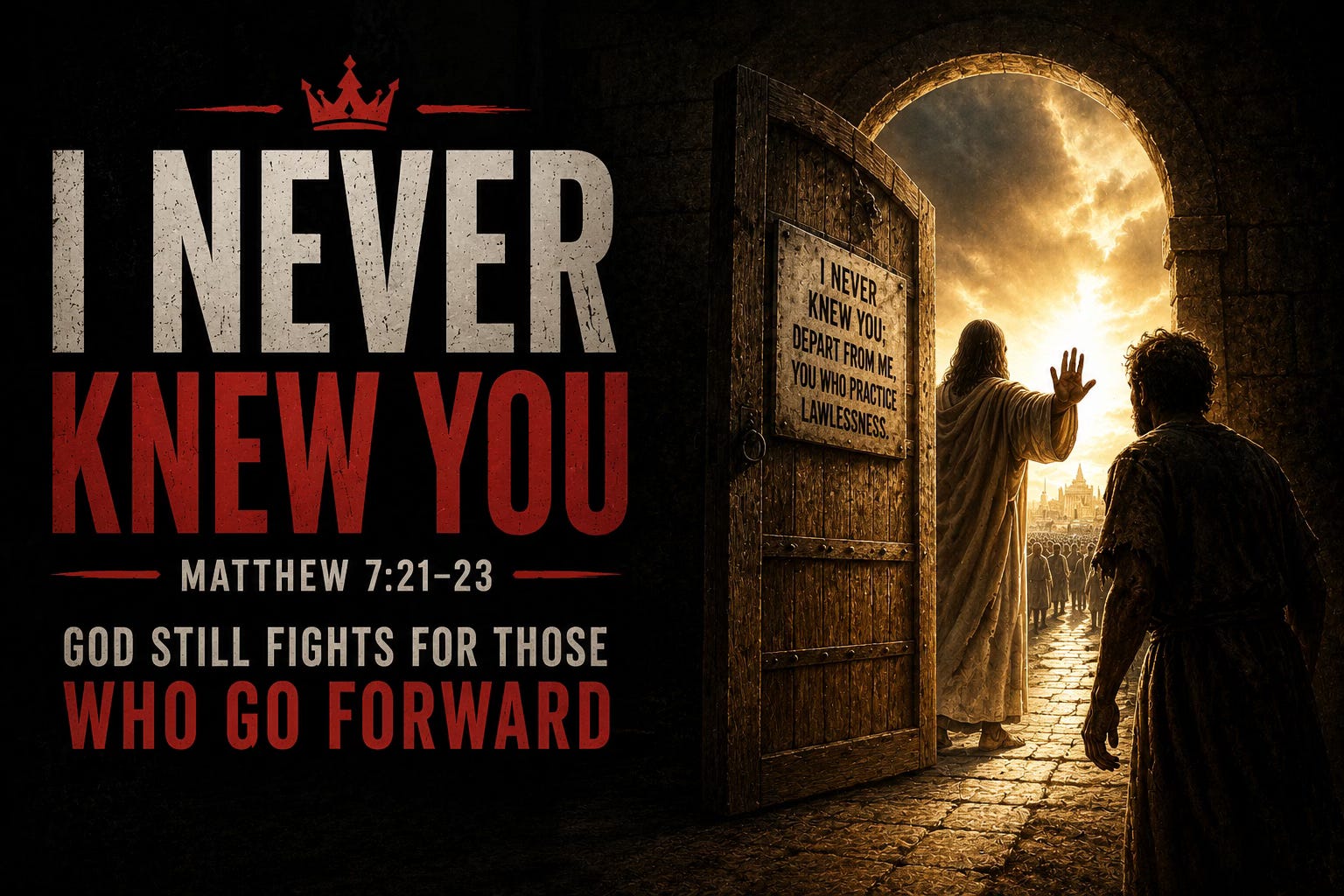
I Never Knew You
Text: Matthew 7:21–23

Text: Matthew 7:21–23
God Still Fights for Those Who Go Forward
I love the account of Israel’s deliverance from Egypt, because in it we see how God continues to work. He did not merely plague the Egyptians until they relented; He made certain that everyone knew it was God, and God alone, who was fighting the battle.
When Pharaoh’s army bore down on them, the children of Israel cried out, “Because there were no graves in Egypt, have you taken us away to die in the wilderness?” Isn’t that so often our attitude? They had just watched plague after plague. They had seen God work and work and work, plainly mastering the whole pantheon of Egypt. Then, at the first sign of trouble, they stopped and said, “Were there no graves in Egypt? You only brought us out here to die.” And yet that is our attitude too. We step out, we meet the smallest opposition, and immediately we say, “Oh, God, You only brought me here to die. You’re not going to do anything.” Spoiler alert: God does something. And He will do something in your life too, if you trust Him.
I love what happens next. The Lord turns to Moses and says:
And the LORD said to Moses, “Why do you cry to Me? Tell the children of Israel to go forward.”
There are times when it is a sin to pray—not often, because we are to pray without ceasing, but here is one of them. The Lord essentially says, “Moses, why are you praying right now? I have already told you what to do. Go forward.” When God has given you the answer, when He has already answered your prayer, and you linger in prayer instead of putting feet to your faith, something has gone wrong. I think there is so much we are missing in the American church today—first, because we don’t pray, and second, because when we do pray, we never actually go forward and walk in the promises of God. But let me tell you: there is no enemy too big for our God, no victory out of His reach, and no promise of His that will ever fail. So when we have secured those promises in prayer, what do we do? We do not stay home and say, “Well, Lord, aren’t You going to do something?” He answers, “I am ready to do something—but I need you to move forward. I need you to go and pursue the victory.”
And pursue it they did. The Lord took the wheels off the chariots. Imagine it. In the midst of all that fear and chaos there must have been a sliver of holy humor. You are an Egyptian. You have these great and mighty chariots—some of them probably plated in gold, for they had wealth and craftsmanship to spare. These were not Chevy chariots; they were Fords. And suddenly the wheels are simply falling off, and you’re shouting, “What is going on? We had the finest craftsmen build these!” God can bring about incredible victory. If we follow Him, trust His word, and pursue His word, He can do things we could never imagine. He can make the wheels come off of our enemy in ways they never thought possible.
The Scariest Passage in Scripture
We have come into the month of October, and as you look around you start to see certain things appear in the culture. October, of course, is the month when everyone tries to scare the living daylights out of everyone else. You drive by and suddenly there are ghouls and goblins and horrific, evil things sprouting up in people’s yards. You can hardly stand to go to the store—I was at Sam’s Club not long ago, and there was a twenty-foot grim reaper looming over the aisle. Absolutely demonic and horrible.
But it set me thinking: what is the scariest passage in Scripture? And so today I want to preach what I believe is the scariest passage in Scripture. There are a few others I would put right alongside it, but this one is certainly on the top tier:
Not everyone who says to Me, “Lord, Lord,” shall enter the kingdom of heaven, but he who does the will of My Father in heaven. Many will say to Me in that day, “Lord, Lord, have we not prophesied in Your name, cast out demons in Your name, and done many wonders in Your name?” And then I will declare to them, “I never knew you; depart from Me, you who practice lawlessness!”
This is about the scariest passage you can get into, because it gives us the true reality of the message.
Not Everyone: The Lie of Universalism
It begins with two words: not everyone. And I am here to tell you today that universalism is wrong. It is a message often proclaimed in our day—that every road leads to the top of the mountain, that every religion leads to heaven. But that is not true. Jesus says not everyone will enter the kingdom of heaven.
This must be proclaimed today, because of what is being taught on the college campuses. I like to go to the campuses and talk with the students. You begin confronting them with moral truth, and they start saying, “Well, this person was good,” or “this is right and this is wrong.” Then you ask them: by what standard is it right or wrong? Almost without exception—I can hardly recall a time it went otherwise—when you press them, they say, “Well, it’s my truth. It’s my truth, and it’s your truth. So you can have your truth, and I’ll have mine.”
This is what our children are being indoctrinated with—hopefully not your children, if you are teaching them better than that. But this is the message America’s children have absorbed: that you can have your truth and I can have mine, that it can all coexist and all be good. Except that if you really believe I am wrong, then you can’t truly have your truth either, because you would simply have to let me believe what I want to believe. It doesn’t make any sense.
Your truth will not get you to heaven. Your neighbor’s truth will not get him to heaven. Universalism will not work. Truth, by definition, is exclusive.
Hell Is Still Hot
Part of the message of Jesus Christ is that hell is still hot today. Most churches have said, “We want to abandon the preaching of God’s word. We want to abandon the preaching of hellfire and brimstone. Those preachers are wrong; those preachers are hateful; those preachers are terrible.” But let me tell you something: you cannot truly love someone without believing that hell is still hot today. Because if you believe hell is not hot, that hell does not exist, that all truths lead to heaven and all religions get you to God, it will condemn their soul—and probably condemn yours as well.
Somewhere along the way we lost this message: that hell is still hot, and that Jesus is the only way. God is holy. We are sinful. And God must judge every man righteously. So without one to intercede and interpose on your behalf, you don’t have a chance. I don’t have a chance. None of us has a chance. The only way is through Jesus Christ, because He tells us in John 14:6, “I am the way, the truth, and the life. No one comes to the Father except through Me.”
If you are having a hard time with this, let me give you a cultural reference—probably more from my era, but perhaps you’ll catch it. Finding Nemo theology isn’t real. The great line in that movie was, “All drains lead to the ocean.” This theology arrived long before the movie did, but it really seemed to pick up steam afterward—as though people watched a movie about a fish and said, “Let’s apply this to our theology. All drains lead to the ocean. All roads lead to heaven.” Let me tell you, you shouldn’t get your theology from a fish. And you certainly shouldn’t get it from a cartoon.
Universalism Past Your Own Two Feet
There are those who wrongly believe in outright universalism. But perhaps worse than that—because you can at least recognize the people who openly believe it. You know the church down the road with the pride flags out front, the one that says all are welcome, live however you want, get to heaven however you want, it’s all good. You can say, “I know that’s wrong, Pastor.” But there is something even worse: those inside the body of Christ who live as though universalism were true the moment it extends past their own two feet.
Let me put it plainly. Do you actually care whether your neighbor is a Christian or not? Have you quietly convinced yourself that your neighbor’s path will get him to the top of the mountain, that it will somehow be okay for him? Do you actually believe and live as though Jesus was telling the truth in John 14:6—that He is the way, the truth, and the life, and that no one comes to the Father but by Him?
It frightens me that we can live in such a way that we do not care about our neighbor—that we say, “I’m perfectly content to go along my merry way as long as I have Jesus,” and never extend that to anyone else. Someone tells us what he believes, and we look the other way. We cannot do that. That is believing in universalism past your own feet. You may not personally believe in universalism, but you are extending it to your neighbor. You are saying, in effect, “I don’t really care if my neighbor goes to hell.”
Let it not be said of us. May our hearts be burdened for the lost. May we love our neighbor as ourselves. If I were wrong about something—if I were on my way to hell—I would sure hope somebody would stop and tell me, “Don’t you know you’re on your way to hell? If you keep going your own way, you will end up in eternal damnation.” I would hope someone would love me enough to say it. So if I am to love my neighbor as myself, I must find a love for my neighbor that is burdened for his soul.
Lord, Lord: Three Kinds of People
It is not merely that the passage says not everyone. It says, “Not everyone who says to Me, ‘Lord, Lord.’” That goes beyond universalism. Often we can grasp the first part easily enough: “Yes, I know the Muslims aren’t going to heaven; I know the Buddhists aren’t going to heaven, because they don’t believe in Jesus.” But then He says, “Not everyone who says, ‘Lord, Lord,’ will enter the kingdom of heaven.”
There are three kinds of people in this world. There are believers. There are unbelievers. We understand those two. But there is a third category, and this one is the most frightening of all: the make-believers.
Make-believers are the most difficult to bring to the Lord, and they are exactly who Christ is describing here. They say, “Lord, Lord.” They can speak fluent Christianese. They know enough of the Bible to talk a little Bible with you. They can slip right into a church service. They may not walk the walk, but they know exactly how to talk the talk—how to look like a Christian, how to say the right things at the right time. They understand the Christian culture. They may even look like a Christian and sound like a Christian.
Jesus presses it further: “Many will say to Me in that day, ‘Lord, Lord, have we not prophesied in Your name, cast out demons in Your name, and done many wonders in Your name?’” There are some who will have had active ministries, and yet Jesus says they will not make it into the kingdom of heaven. It is scary, because Christ says many. Many on that day will be make-believers. It is a terrible thing to be an unbeliever, but it is a terrifying thing to be a make-believer. And America today is filled with both.
A Make-Believing Nation
We are a nation under the judgment of God for all the wickedness we have done. We have made a mockery of marriage. We have marred His image through the slaughter of the innocent. And yet we pretend we are a Christian nation, the greatest thing since sliced bread, and that God is going to come down and lay His hand of blessing upon us. Let me tell you, we are a nation under judgment—and worse, a nation under judgment whose prophets cry, “Peace, peace,” when there is no peace. We are a make-believing nation.
And I love America. I love the founding of our nation. I believe it was founded on the principles of God. The founders were not perfect, but they were striving and aiming toward the Lord, trusting in providence. There is no way they could have beaten the redcoats without God intervening. But we have drifted from that. Our founding fathers would roll over in their graves if they saw the decay of our nation today.
Yet Christians walk around as though we were not in a pagan land, a foreign mission field. I remember a song from my youth: “Millions still in every land grope in sin’s dark night; who will lend a helping hand, lead them to the light?” Those millions are right in front of us. Another hymn: “Far, far away, in heathen darkness dwelling, millions of souls forever may be lost; who, who will go, salvation’s story telling, looking to Jesus, heeding not the cost?” I love that we have a heritage of missions in this nation. But here is what I am afraid to tell you, because people don’t like to hear it: we need to stop—and I love foreign missions; I am not anti-missions—we need to stop thinking the mission field is only in China or Africa or across the world. We need to start realizing that God has placed us in a foreign field today. We are within a pagan land. This is no longer a Christian nation. People need an encounter with Jesus Christ. They need to bow the knee before the King of kings and the Lord of lords.
The fear of the Lord is the beginning of wisdom, and we are a nation largely comprised of fools. I don’t want you to be a categorical fool today. I want you to be wise—and that means you must fear the Lord. This is a weighty subject.
Whose Kingdom Is It?
You might be thinking, “Okay, Pastor Sam—if not everyone is going to make it, and even religious people who prophesied and cast out demons and did many wonders in the Lord’s name won’t make it, then who will enter the kingdom of heaven?” I’m glad you asked. Jesus answers it right here: “He who does the will of My Father in heaven.”
Here is something you must know about the kingdom of God, and I feel we especially need to say it in America, because we have built up a false individualism, a false sense that it is all about me. Just consider: what is the most popular kind of picture taken today? It isn’t the portrait. It’s the selfie. It’s all about me. This whole life—it’s just about me, me, me.
Here is what you need to know about the kingdom of God: it is not your kingdom. You are not the king in the kingdom of God.
Yesterday there was a “No Kings” protest all across our nation. But understand—they do want a king. A brother of ours, Jeremy, went out to one of these protests to confront people with the gospel, with their sin. I praise the Lord he did. He sent me one of the greatest texts I have ever received: “Pastor, I’ve lost my voice from shouting, ‘No king but Christ—Jesus is King.’” There is no better reason to lose your voice than to proclaim that Jesus Christ is King. I told him, “Just as the King will return, so will your voice, Jeremy. The Lord has more times for you to go out and proclaim that message.”
But he also showed me a picture—and this is what I am driving at. It was a person dressed in a French costume from the era of the French Revolution, holding a guillotine. You see, the “No Kings” protest is trying to borrow from the French Revolution. And I am very much concerned about the French Revolution being upon us for some time, because we have so many people running toward this idea while choosing lesser evil after lesser evil after lesser evil. I keep wanting to ask: do you not understand that a Christless conservatism doesn’t work? It doesn’t work. It leads to a French Revolution—and a French Revolution, in case you are curious, is simply leftism.
It is hyper-individualism, rooted in what Thomas Paine called the rights of man—the belief that every society, every generation, could write its own social contract and its own laws. It was about taking one king, dethroning him, and crowning themselves king instead. “I don’t want one tyrant; I want ten thousand tyrants. We can all be tyrants.” That is the very message of yesterday’s protest: we do want a king—I just want to set myself as king.
Unfortunately, the modern response to this has been nothing but a different form of the same French Revolution, a different individualism we call populism. “Let’s gather everybody’s ideas, see what we think, and craft a message that appeals to everyone; then we’ll see what’s right.” The problem is that populism doesn’t find what’s right. It finds what’s popular. And what’s popular—throughout all of history—is sin, because nobody likes to be told he’s wrong. People like to be told, “Do what’s right in your own eyes. You make the decision. You do you.”
This is how we can claim we’ve had a great turning back toward Christ while we have a first-term president who is pro–gay marriage. I’ll be honest with you: if you set Bill Clinton’s policies and statements beside Donald Trump’s, Bill Clinton is actually more conservative. Isn’t that wild? It is a symptom of the fact that we have not had people step out and say, “I don’t care what comes against me. I don’t care if the whole sky falls on my head. I am going to stand for God’s law. God is right, and I don’t care if anyone stands with me. God is right, and I will not be moved. God’s law reigns. Jesus is King.”
Who will enter the kingdom of heaven? Those who do the will of the Father—those who recognize it is not my kingdom but God’s. It’s not about my truth, my ways, my wants, my desires. It’s about my King’s wants, my King’s desires, my King’s law. I have bowed my knee to Jesus Christ. The Bible is clear: there is a King, and He is the King of kings and the Lord of lords, and one day every knee will bow and every tongue confess that Jesus is Lord, to the glory of the Father.
God Gave What We Needed, Not What We Wanted
Salvation is not about what you want. One failure of the modern church is that we have propped up the individual so greatly that we have told each person the world revolves around him. It doesn’t revolve around you. The world revolves around the Son—if you get my drift.
In John 3:16, perhaps the most famous verse of all, it says, “For God so loved the world that He gave His only begotten Son, that whoever believes in Him should not perish but have everlasting life.” God gave. And what did He give—what the people wanted, or what the people needed? It was not what they wanted; it was what they needed. They wanted a physical ruler who would establish an earthly kingdom and dethrone the Roman emperor, setting up an Israelite kingdom. But God sent an eternal King, a King of kings and Lord of lords, who suffered and went to the cross and died to take my place and yours, so that our sins could be forgiven.
Do not think that makes Jesus weak. Jesus comes again. And when He returns the second time, He does not come to be born and laid in a manger. He comes riding a horse, with a sword in His hand, to make war with His enemies. I am not preaching a weak Jesus. I am telling you that Jesus first said, “I will establish justice, and because My law has established justice, I will come and bring mercy to you. I will give you time to accept My mercy.” But make no mistake—justice will be fulfilled.
God did not give the world what it wanted. He gave it what it needed. You may want a simple get-out-of-hell-free card, but what you need is the gospel of the kingdom that rules your life. Real salvation produces people who want the will of the Father. If you walk through every day thinking only about three people—me, myself, and I—then you had best be afraid, because those who do the will of the Father are the ones who will enter the kingdom of heaven. If your thinking never gets beyond yourself, you should fear for your soul.
The Narrow Gate
Those who enter the kingdom also enter through the narrow gate. We read in verses 13 and 14:
Enter by the narrow gate; for wide is the gate and broad is the way that leads to destruction, and there are many who go in by it. Because narrow is the gate and difficult is the way which leads to life, and there are few who find it.
We must go through Christ. And to believe in Jesus is not an intellectual act—it is a moral one. I believe many people miss heaven by about eighteen inches: the distance from the head to the heart. It takes a man all he is worth to believe in Jesus Christ. There are atheists today, sympathetic toward Christianity in some strange way, who can articulate the gospel better than I can—and yet they do not believe in Jesus. You must go through Christ. The way is narrow; it is difficult; and few find it.
I don’t want to sound like a Debbie Downer—you know I hate pessimism—but I do want you to feel the weight of the spiritual reality in front of you today. People are dying and going to hell. Do we care about that, Christian? Do you care about that today?
Do We Care About the Lost?
I think of some of the old hymns I learned. “Like Jesus, I long to be winning men who are lost and constantly sinning.” “Rescue the perishing, care for the dying; Jesus is merciful, Jesus will save.”
We ought to worship the Lord. We ought to set our eyes on God—I understand this. But I am afraid we have so internalized our Christianity that we excuse ourselves, saying we are worshiping God when in reality we have put ourselves in Jesus’ place. Because we refuse to be uncomfortable, we refuse to pay a price, we refuse any cost in winning people to Jesus Christ.
Will we put ourselves in uncomfortable positions and say, “Even if it costs me everything, I will believe in Jesus, and I will share Jesus with my neighbor—because He is King, and He comes back to make war, and I do not want my neighbor to be an enemy of the cross”? We say grand things: “I would die for Jesus. I would crawl over broken glass to share the gospel.” We say foolish things like that, when the reality is that we won’t even turn to our neighbor and tell him about Jesus. You have had opportunity after opportunity—and have you shared the gospel with the people around you?
We comfort ourselves by simply assuming everyone is saved. But Jesus is clear: broad is the path that leads to destruction, and wide is the way; narrow is the path that leads to life, and few find it, and it is difficult.
By Their Fruits
Those who enter the kingdom of heaven enter through the narrow gate, they do the will of the Father, and they also bear good fruit. We read in verses 15 through 20:
Beware of false prophets, who come to you in sheep’s clothing, but inwardly they are ravenous wolves. You will know them by their fruits. Do men gather grapes from thornbushes or figs from thistles? Even so, every good tree bears good fruit, but a bad tree bears bad fruit. A good tree cannot bear bad fruit, nor can a bad tree bear good fruit. Every tree that does not bear good fruit is cut down and thrown into the fire. Therefore by their fruits you will know them.
This is a warning. What is the fruit of our lives? We ought to bear the fruit of the Spirit. We ought to be bearing fruit.
I have been convicted recently. Do I really love my neighbor? Am I truly sold out for Christ? I know the football game is calling. I know the cares of this life are pressing. But through it all I must ask: am I sold out for Jesus Christ? I am tired of living an apathetic life. I refuse to be comforted by a Christian veneer. Give me Christ, or I die. I pray that is our heart’s cry—give me Christ, or I die. Is that what drives every step forward? Give me Jesus. Take the world, but give me Jesus. I am afraid the Christianity we live in today says, “I will accept the world, and I will slap a Jesus sticker on it.”
No Empire Survives Moral Decay
We must not live apathetically. Time is pressing; it is marching on; the hour is getting late. Our nation is crumbling. We may like to prop it up with American exceptionalism, but let me tell you, there is no empire that can withstand the weight of moral decay, because moral decay crumbles the foundations—and because Jesus is the Judge of all nations. He is not about to apologize to Sodom and Gomorrah. He is not about to apologize to Babylon. He is not about to apologize to the Roman Empire.
So if America does not repent—and that repentance starts with individuals, and it starts in the house of God; if Christians will not repent and say, “I will live for Jesus no matter what”—then our nation is bound to crumble and be destroyed. Look at our fruit.
Depart From Me: The Most Terrifying Words
Who will enter the kingdom of heaven? Those who do the will of the Father, who enter through the narrow gate, who bear good fruit, and who do not practice lawlessness. For Christ says, “And then I will declare to them, ‘I never knew you; depart from Me, you who practice lawlessness.’”
These are the most terrifying words of all. I don’t want to hear them over my own life. I don’t want my neighbor to hear them. I certainly don’t want you to hear them. I don’t want anyone to hear those words: Depart from Me. I never knew you, you who practice lawlessness.
The Gospel Is the Size of a Kingdom
For decades we have heard from American pulpits—whether intentionally or unintentionally—that the gospel is the size of a casket. But I am here to tell you the gospel is not the size of a casket. The gospel is the size of a kingdom. Jesus’ gospel does not merely prepare you to die; it prepares you for how to live in this world.
Jesus has laws, and we have broken them—and that is why we need Jesus. People think it is legalistic to preach this, but it makes no sense to cast out the law. If what you mean when you say Jesus fulfilled the law is that He took the law, ripped it to shreds, and threw it away, then we don’t need a sacrifice at all. Jesus fulfilled the law—that is, He was perfect, and that is why He could be the sacrifice. When Scripture says we are justified, that is a legal term. When it says He is our propitiation, that is a legal term. When it says we are redeemed, that is a legal term: Jesus went to the cross to pay the price for us because we had broken the law.
That is why we need Jesus, and that is why we must proclaim the law of God. Psalm 19:7 tells us, “The law of the LORD is perfect, converting the soul.” God would not call it perfect if it were not. When you proclaim the law of God, it makes every man guilty before God. It made me guilty before God. There was a confrontation with the cross: I am not good enough to get to heaven. I am destined for hell. I deserve hell. But Jesus paid the price for me. He took my place.
I love this, because He was our ransom. And as a ransom, it is not merely that He paid a price to bail us out of hell—it is that He took our place. He took the wrath of God upon Himself.
A King, and a Law
The gospel is the size of a kingdom. Kingdoms have a king, and kings have laws, and our King is Jesus Christ. He is the King of kings; He is the Lord of lords; His law reigns supreme; and His law prepares us to live.
We can summarize the law of God in two commands, expressed throughout Scripture: love the Lord your God with all that you are, and love your neighbor as yourself. We could take the Ten Commandments, set the first four on one side and the last six on the other, and see that this is how you love the Lord your God, and this is how you love your neighbor. We could walk through Leviticus and Deuteronomy and the moral law, through the second half of Exodus, and see what it means to violate these commands—and we would find that we must apply them to our lives.
Jesus saves us, but He saves you from sin; He does not save you to sin. Sin is transgression of the law—that is what it means. When you do righteousness by loving your God and loving your neighbor, you are obeying the law of God. Love loses all its meaning when it is removed from law. Christ is King, and we must obey Him.
Does Christ Know You?
The question that faces us today—the question we will end on—is this: does Christ know you? He spoke those terrifying words: I never knew you. I never knew you. I never knew you. Does Jesus Christ know you today?
I love the promises of God. Romans 10:9 tells us that if we confess with our mouth the Lord Jesus and believe in our heart that God has raised Him from the dead, we shall be saved. And a few verses later, Romans 10:13: “Whoever calls on the name of the LORD shall be saved.”
Does God know you? If not, you need to turn to Him today. You need to bow your knee to the King of kings and the Lord of lords. You need to surrender your life to Him.
And to those who are saved today, those whom Jesus does know—you say, “Pastor, I know Jesus; Jesus knows me; we go way back.” Praise the Lord. But the question I present to you is this: do you need to repent of your apathy? Have you truly been living on fire for Jesus Christ?
This passage convicts me. It makes me look inward. Does Jesus know me? And then I begin to ask: do I actually live as though these are true? That one day Jesus will judge, that He will return triumphantly—do I really live my life inside that truth? Because if I do, I am going to care deeply about my neighbor. When my neighbor says, “I’ll live my truth and you live yours,” that is not going to be good enough for me.
One of my spiritual gifts—I’ve said it for years, half-jokingly, but only half—is the gift of annoyance. It is persistence. Am I persistently seeking the souls of those around me? Am I persistently, annoyingly seeking to see our culture repent and turn to Jesus Christ? Or am I content to check the box—”I did it once; I preached it one time; I said it once; I’m good enough”? There is a way to do the bare minimum with a veneer of faithfulness, just enough that no one can level an accusation against you. But it is not your neighbors who will judge you, and it is not I who will judge you. It is Jesus Christ Himself. And He knows whether your heart is truly on fire for Him—whether you are truly bowing your knee before Him, recognizing that He is King of kings and Lord of lords, and that you are called to be an ambassador of Jesus Christ, carrying the message of His kingdom into a lost and dying world.
That is a conviction in my heart today. Perhaps it is a conviction in yours.
If you do not know Jesus Christ as your Savior today, I don’t want you to leave without knowing Him. I want you to turn to Jesus Christ and call upon Him. Admit that you have sinned. Tell Him you believe that Jesus is the only one who can save you. And in your heart, choose to follow Him. That is how you are saved.
But if you are a Christian today, I want you to consider: are your neighbors in danger of hearing Jesus say to them, “Lord, Lord”—and hearing Him answer, “I never knew you”? We need a burden for the lost today. We need a burden for Christ’s kingdom. We need a burden to truly surrender our lives to Jesus.
Let Us Pray
Father, this passage is terrifying if we take it at its word. There will be many on the last day who will say, “Lord, Lord,” and You will say, “I never knew you,” and You will not let them enter the kingdom of heaven.
Father, I am not trying to preach a gospel narrower than the way You have set—but I pray I am not preaching one wider than the way You have set, either. I pray that our lives, that my life, would live in the reality of this passage: that I would realize there are people lost and dying and going to hell. I pray my heart would be moved, that I would love my neighbor because I love You. Lord, let our love not grow cold. Let our love be deep enough and strong enough to tell people the truth—that Jesus is the only way, that none will come to heaven but by Him.
Father, give us hearts—give me a heart—for my neighbor, that I might see him saved. But let it not be a salvation that is merely the gospel of a casket. Let there be the proclamation of the gospel of a kingdom: not a mere get-out-of-hell-free card, but a gospel that changes a life, so that they seek to serve You in every area, realizing You are the King of kings and Lord of lords, and surrendering everything to You. And Father, I pray that our neighbors might repent with us as we turn from our sins and turn toward You.
Father, be high and lifted up. In Jesus’ name we pray. Amen.